Alghadban.
A bilingual English/Turkish fine-jewellery website for Alghadban in Istanbul

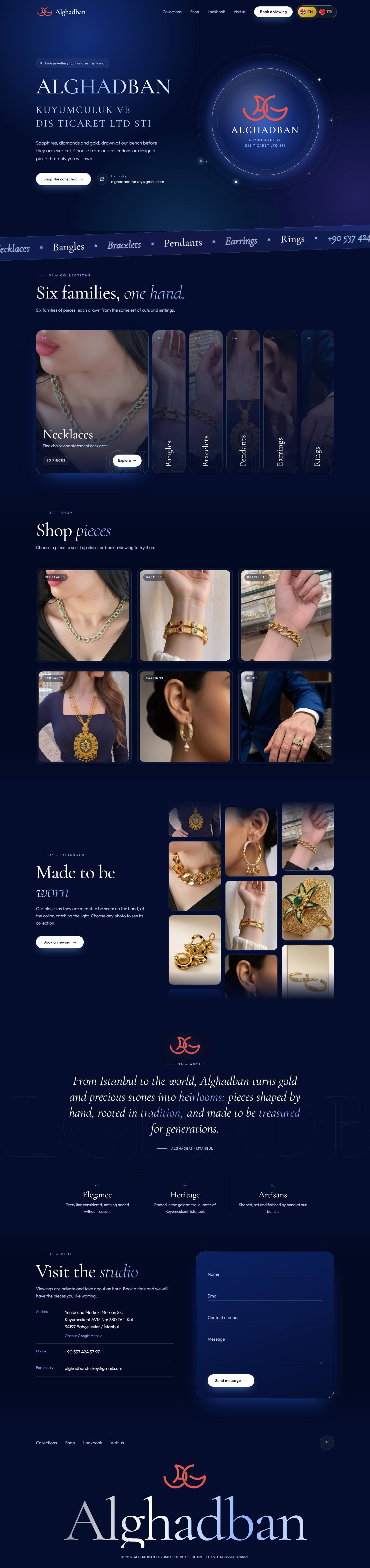
Alghadban is an Istanbul-based fine jewellery brand. I built a bilingual English/Turkish website that presents handcrafted collections, a lookbook and private viewing bookings — developed with Next.js, focused on a luxury visual identity, responsive layout and fast page loads.
- Client
- Alghadban
- Industry
- Fine jewellery
- Location
- Istanbul, Türkiye
- Role
- Freelance developer
- Services
- Next.js developmentBilingual (EN / TR) websiteBooking flowSEO & performance
Tech stack
09 toolsSee it on every screen
Hover to pause · scroll or drag the bar to explore
What Alghadban needed
Two languages, one brand
The site had to feel equally natural in English and Turkish without duplicating effort for every page.
Craftsmanship on screen
Handcrafted pieces needed a presentation that shows texture and detail, not just product thumbnails.
Private viewings
High-value clients prefer to see pieces in person, so booking a viewing had to be effortless.
Speed with rich imagery
A lookbook full of large photos still had to load quickly, especially on mobile.
How I solved it
Bilingual Next.js build
A single codebase serving English and Turkish content, with a clean language switch.
Lookbook experience
Editorial-style collection pages that let the craftsmanship lead.
Viewing bookings
A simple enquiry and booking flow for private appointments.
Fast page loads
Server rendering and optimised imagery keep the luxury feel without the wait.
What it delivered
One site for two audiences
International and local clients get the same premium experience in their language.
A direct line to clients
Viewing requests come straight from the website.
Search-ready collections
Server-rendered pages help the collections get found.
Bilingual English/Turkish fine-jewellery site with a lookbook and private viewing bookings.
My process for building Alghadban
- 01.
Discovery Call
We map out your goals, audience, must-have features, timeline and budget, so the business comes first and the code second.
0%· Requirement brief - 02.
Scope Document
Everything we agree is written into a clear scope: features, pages, user flows and acceptance criteria. You sign it off before work begins.
0%· Signed-off scope - 03.
Tech Stack & Architecture
I choose the frameworks, database, hosting and integrations that fit your performance needs, growth plans and budget.
0%· Architecture plan - 04.
Research & Prototyping
The risky parts (third-party APIs, payments, real-time data) are tested early with quick prototypes, so nothing surprises us later.
5%· Proof of concept - 05.
Development Sprints
Building in focused sprints with regular progress updates and a private staging link you can open at any time.
25%· Live staging site - 06.Client checkpoint
Midpoint Review · 50%
At the halfway mark the first half is handed to you for hands-on testing, while I run full developer QA in parallel.
50%· Feedback & fixes - 07.Client checkpoint
Approval & Final Build
Once you approve the first half, your feedback is applied and the remaining 50% is completed to the same standard.
100%· Feature-complete build - 08.
Final QA & Client Testing
Complete testing from both sides: you validate every flow, and I test across devices, browsers, speed and edge cases.
100%· Launch approval - 09.
Deployment & Handover
Go-live on your domain with hosting, SSL and analytics set up, followed by a full handover and post-launch support.
100%· Live product